
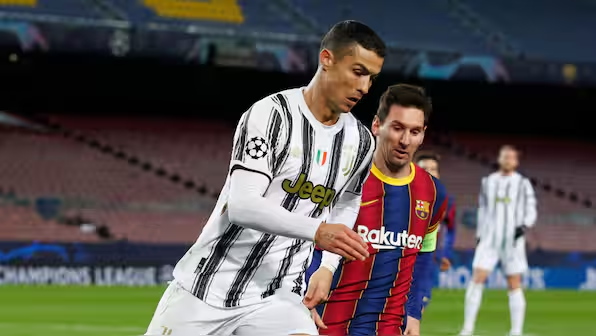
Cristiano Ronaldo Versus Messi Debate That Will Never Actually Be Settled
No sports argument has aged the way this one has. The Ronaldo Versus Messi question is not only about goals, trophies, dribbles, headers, records, or World Cup nights. It is about what people think greatness should look like when the evidence points in two different directions. One player made genius feel natural. The other made self-invention feel heroic. That split is why the fight keeps surviving every new stat graphic, highlight reel, and barbershop take.
For American fans, the argument has a special bite because many found soccer through clips, Champions League nights, World Cup summers, and sports culture coverage rather than through one hometown club passed down by family. That makes the debate more open, but also more emotional. You are not only picking a player. You are picking a story. The wiser answer is that this argument will never close because the two cases are built on different values. Messi asks what happens when football looks like art. Ronaldo asks what happens when ambition refuses to age.
Why the Ronaldo Versus Messi Argument Stays Personal
Every long-running sports argument needs more than numbers. It needs identity. That is why this comparison has outlived Barcelona against Real Madrid, La Liga dominance, Champions League cycles, and the club moves that sent both men into new chapters. Fans keep returning to it because each player gives them a different mirror. One side sees instinct, balance, and the small joy of a pass nobody else noticed. The other sees hunger, power, training, and a career built against doubt.
The debate is about taste before it is about proof
A New York fan watching Messi at Inter Miami may feel pulled toward the soft touch, the pause before a pass, and the sense that the game slows down around him. A kid in Los Angeles watching Ronaldo clips may see the leap, the sprint, the stare before a penalty, and the refusal to look finished. Neither fan is wrong. They are seeing different forms of excellence.
That is the hidden trap inside the football GOAT debate. People pretend they are arguing evidence, then defend what they already love. Messi rewards viewers who value flow. Ronaldo rewards viewers who value force and intent. Once taste enters the room, a spreadsheet cannot escort it out.
There is a counterintuitive lesson here: the cleaner the evidence becomes, the harder the argument can get. More goals, assists, trophies, and clips give each side fresh material, not closure. A debate with thin evidence ends quickly. A debate with too much evidence becomes a permanent neighborhood argument.
The same thing happens in youth soccer circles across the U.S. A coach may praise Messi when teaching first touch in tight space. A strength trainer may point to Ronaldo when talking about body care, leap mechanics, and repeat sprint habits. Both examples are useful. They teach different kids different truths.
American sports culture makes the argument louder
In the United States, fans are used to ranking legends. Jordan or LeBron. Brady or Montana. Serena or anyone who dared get close. So when American soccer fans meet the Messi-Ronaldo split, they bring a familiar habit: find the winner, crown him, move forward. Soccer does not make that neat.
The sport spreads value across ninety minutes. A player can shape a match without scoring. A forward can vanish for an hour, then decide the night with one violent touch. That makes a soccer legacy comparison harder than an NBA box-score argument. You have to decide how much weight belongs to creation, finishing, movement, leadership, pressure, and the strange gravity a player carries.
A specific example helps. At a packed sports bar in Chicago during a World Cup knockout match, you might hear one fan praise a Messi pass that opened a defense by two yards. Ten seconds later, another fan will say Ronaldo would have attacked the far post and scored. They are not watching the same question. One is grading the chess move. The other is grading the kill shot.
That difference is why the argument spreads so well in America. Soccer is still gaining ground in many cities, so fans often learn the sport through stars before they learn tactics. Messi and Ronaldo became entry points. Once a player becomes your doorway into a sport, changing your mind can feel like leaving your first team behind.
What the Numbers Reveal and What They Hide
The numbers matter. Anyone who says otherwise is dodging the hard part. Ronaldo’s case gains force from volume, Champions League records, and a career that stretched elite scoring across clubs, systems, leagues, and age. Messi’s case gains force from scoring plus creation, his Barcelona peak, Argentina’s late-career triumph, and the way his passing turns teammates into threats. The math is serious. It is not final.
Why Messi and Ronaldo stats cannot settle taste
The phrase Messi and Ronaldo stats gets searched because people want a clean answer. Goals. Assists. Appearances. Trophies. Awards. International records. Champions League rankings. There is value in lining those up, especially when using an official source such as UEFA’s Champions League all-time player rankings. Ronaldo’s name sits high in the European club record book, and Messi’s name lives there too, close enough to keep every comparison alive.
Yet the numbers ask a follow-up question: what do you reward most? If you reward pure scoring hunger, Ronaldo’s case gets stronger. If you reward chance creation beside scoring, Messi’s case swells. If you reward winning the biggest international prize, Messi’s 2022 Argentina run carries heavy emotional force. If you reward doing it across different club cultures, Ronaldo answers with Manchester United, Real Madrid, Juventus, and Portugal.
That is why the raw count never ends the matter. A goal in a Champions League final feels different from a league goal in February. A pass before the assist may matter more than the assist itself, but it often disappears from basic tables. A sprint that drags a defender away can create the goal, yet the stat sheet stays quiet. Soccer keeps some of its truth off the page.
Another issue sits beneath the totals. Players are not asked to do the same job in every team. Barcelona often gave Messi the ball in zones where he could conduct attacks. Madrid often gave Ronaldo the last action after the team had bent the field toward him. Both roles were difficult. They produced different kinds of proof.
The trophy cabinet creates new arguments, not peace
Trophies should help. They often do the opposite. Messi fans point to the World Cup, the Copa América, Barcelona’s best years, and individual awards. Ronaldo fans point to five Champions League titles, Portugal’s Euro 2016 win, his scoring records, and the way he kept producing after leaving the team that suited him best.
The problem is that team trophies are shared proof. They tell you a player mattered, but they do not tell you exactly how much of the weight he carried. Portugal winning Euro 2016 with Ronaldo injured in the final creates a strange debate inside the debate. His leadership and tournament helped get them there, yet the final itself became a test of team survival. Argentina’s 2022 World Cup made Messi’s story feel complete, but it also came with penalty pressure, goalkeeping heroics, and a team built around sacrifice.
Here is the non-obvious part: the more complete each résumé becomes, the less useful the résumé becomes as a weapon. If one man had the goals and the other had the trophies, the split would be simple. Instead, both have enough of everything to make the missing pieces feel smaller. That is why greatest athletes comparison guide debates often become values tests rather than verdicts.
Think about how fans talk after a major final. The winning side remembers leadership, aura, and belief. The losing side may remember missed chances, referee calls, or a teammate’s injury. The same match becomes two histories by the next morning. Trophies matter, but memory edits them.
Peak Performance Creates Two Different Legends
A career can be judged by its whole length, but fans usually fall in love with a peak. The peak is the version you remember when your argument gets heated. Messi’s peak felt like control over space itself. Ronaldo’s peak felt like pressure turned into a body. Both were absurd. They were absurd in opposite ways.
Messi made hard things look quiet
Messi at Barcelona did not always seem to defeat defenders. Sometimes he made them irrelevant. He could receive the ball near the touchline, take one touch inside, and change the map before anyone else adjusted. That is why many coaches, analysts, and former players talk about his game as if it belonged to a different rhythm.
For American fans who came to soccer through highlight clips, Messi’s gifts may be easy to miss at first. The dribble is clear. The curled finish is clear. The pass before the pass is less obvious. You need to watch the defender’s hips, the timing of the run, and the way Messi waits an extra beat. That extra beat is where the damage happens.
The quiet part of his game is also why some fans underrate him when they want spectacle. He did not always look as if he was straining. That can trick the eye. Effort is easy to cheer. Ease can look unfair, which makes it harder to measure and easier to argue against.
Messi’s best games often leave a strange aftertaste. You remember one finish, then later notice the five smaller choices that made the finish possible. A shoulder drop near midfield. A pass into the runner’s safer foot. A walk that saved energy before a burst. His genius ages well on rewatch because it hides in small decisions.
Ronaldo turned self-belief into a football weapon
Ronaldo’s peak had a different charge. At Manchester United, he was a winger with tricks, pace, and swagger. At Real Madrid, he became a scoring machine with brutal timing. Later, he adapted again, trading some movement for box craft, aerial power, and penalty nerve. Few legends have rebuilt their own style so many times in public.
This matters in the soccer legacy comparison because adaptation is a form of greatness. Ronaldo did not stay the same and wait for the sport to honor him. He changed shape. He learned where the goal would be before the cross came. He mastered the psychological theater of the big moment, especially in Europe.
A common criticism says Ronaldo depends more on service than Messi. There is truth there, but it can be overstated. Getting service at the highest level is not an accident. It comes from movement, fear, and the defender’s panic. When a player arrives at the far post over and over, the tap-in is not cheap. It is the receipt for all the running you did before the camera noticed.
That lesson travels beyond soccer. American athletes in other sports often admire Ronaldo because his greatness looks trainable, even if his ceiling was rare. Sleep, diet, repetition, confidence, finishing drills, body work. The myth says you can build toward him. Messi feels harder to copy, which may be why Ronaldo’s appeal reaches people who want a manual.
The Modern Fan War Is Bigger Than Soccer
The old debate lived in pubs, schoolyards, radio shows, and matchday arguments. The modern one lives online, where every clip can become a trial and every missed chance can become evidence. That environment has changed the tone. It rewards certainty, not fairness. It turns admiration into combat.
Social media made the football GOAT debate endless
A ten-second clip can make either player look like the answer. Messi slides through four defenders. Ronaldo hangs in the air for a header. Messi bends a pass through a gap no camera angle saw at first. Ronaldo scores in stoppage time and reacts as if destiny signed the paperwork. Each clip feels final until the next one appears.
That is why the football GOAT debate became perfect social media fuel. It is visual, emotional, tribal, and impossible to close. Algorithms do not want settled arguments. They want comments, quote posts, angry replies, and fans rushing in to defend their side. A balanced take often dies quietly. A wild take travels.
The odd result is that younger American fans may know the argument before they know the full careers. They inherit the fight through edits, reaction videos, and comment sections. Then they work backward into the history. That can create passion, but it can also flatten both players into mascots for rival camps.
A teenager in Dallas may see a thirty-second montage before watching a full match from either player’s prime. That is not laziness. It is the way sports history now arrives. The danger is that clips reward the loudest moments, while soccer’s deepest value often lives between them.
Club loyalty, national pride, and personality all get mixed in
No fan brings a clean mind to this. A Real Madrid supporter may feel Ronaldo’s Champions League nights in the chest. A Barcelona supporter may see Messi as the face of the most beautiful club football they ever watched. An Argentina fan carries decades of longing that ended in Qatar. A Portugal fan sees Ronaldo as the man who made a smaller football nation feel huge.
Personality adds another layer. Ronaldo’s confidence makes some fans admire him more and others pull away. Messi’s reserve makes some fans see purity and others see less command. These reactions are not side issues. They shape how people read the same event. A celebration can look inspiring to one person and arrogant to another. A quiet walk can look humble or passive, depending on the eyes watching.
The mildly uncomfortable insight is that many people are not defending the better player. They are defending the version of greatness that makes sense to their own life. If you believe talent should feel natural, Messi looks like the answer. If you believe greatness is built through work, hunger, and defiance, Ronaldo feels impossible to dismiss. That is why modern soccer fan culture keeps this argument alive even as both careers move toward their final chapters.
There is freedom in admitting that. You can prefer one without shrinking the other. You can say Messi moved you more or Ronaldo inspired you more, and that may be the honest core of your answer. The fight gets uglier when fans dress personal feeling as court evidence.
Conclusion
The smartest way to watch this rivalry is not to beg for a final ruling. It is to admit that two different ideals reached the same mountain from opposite sides. Messi gave football its softest kind of violence: a touch, a pause, a pass, then a defense opened like a door. Ronaldo gave it the drama of refusal: jump higher, shoot harder, return older, score again.
That is why the Ronaldo Versus Messi question survives every award ceremony, stat table, and tournament ending. It is not a weak debate because it lacks evidence. It is a strong debate because the evidence supports two honest answers. American fans who want one clean verdict may be missing the gift in front of them.
Sports rarely gives us twin legends with such different shapes at the same time. The better move is to study both, argue with care, and let the disagreement stay alive. Pick your side if you want. But watch the other man closely too, because the best part of this rivalry was never the winner. It was the standard they forced each other to chase.
Frequently Asked Questions
Why do fans still argue about Messi and Ronaldo after so many years?
Both careers support a strong case, so the argument never runs out of fuel. Messi offers playmaking, control, and World Cup glory. Ronaldo offers scoring volume, Champions League dominance, and rare longevity. Fans also defend the style of greatness they admire most.
Who has the stronger case based on Messi and Ronaldo stats?
It depends on the category you value. Ronaldo’s scoring volume and Champions League record help his case. Messi’s assists, playmaking, and efficiency support his side. Stats can guide the discussion, but they cannot measure every off-ball run, pass, or tactical effect.
Is Messi better than Ronaldo because he won the World Cup?
The World Cup gave Messi’s case a major boost, especially for fans who value international legacy. It does not erase Ronaldo’s club records or Portugal achievements. It changes the emotional weight of the argument more than it creates a full mathematical answer.
Is Ronaldo better than Messi in Champions League history?
Ronaldo has the stronger Champions League scoring and big-night case, especially from his Real Madrid years. His knockout record and title haul matter. Messi still has an elite Champions League résumé, so the gap is meaningful but not enough to end the whole debate.
Why do American soccer fans care so much about this debate?
Many American fans discovered global soccer during the Messi-Ronaldo era through TV, social media, video games, and World Cup coverage. Since they did not all inherit one local club identity, the player debate became a natural entry point into the sport.
What makes the soccer legacy comparison so hard?
Soccer value is spread across movement, passing, pressure, finishing, leadership, and timing. Some of that shows in stats. Some does not. A player can control a match without scoring, while another can decide a match with one late chance.
Can younger players pass Messi and Ronaldo someday?
A future player can pass some records, but matching their shared era will be hard. They dominated the same period, pushed each other, and turned every season into a referendum on greatness. The rivalry itself is part of the legacy.
What is the fairest answer to the football GOAT debate?
The fairest answer is that your criteria decide your winner. Choose Messi if you value control, creation, and natural rhythm. Choose Ronaldo if you value scoring force, reinvention, and longevity. A serious fan can defend either side without pretending the other case is weak.